
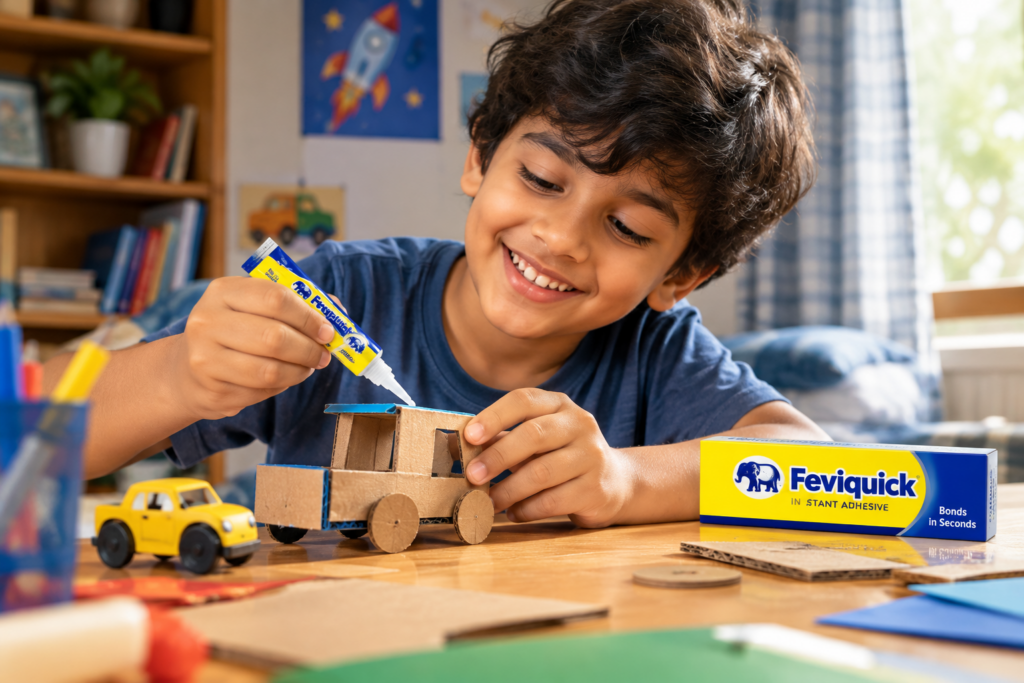
A craft activity can seem harmless to a child, but one moment of unsupervised use of an instant adhesive can turn into an eye emergency.
A recent case handled at Dr John Eye Care, Grace Hospital Complex, Kaliyakkavilai, involved a child whose eyes were exposed to Feviquick during a craft activity. The child arrived with severe pain and was unable to open his eyes. According to the treating doctor’s account, the adhesive had to be carefully removed, and the child improved after the glue was removed.
The incident highlights an important message for every parent:
Children should not handle instant adhesives such as Feviquick without close adult supervision.
According to the case described by the treating doctor, a mother suddenly arrived with her child in distress.
The child was experiencing significant pain and could not open his eyes. When asked what had happened, the child explained that he had been using Feviquick while doing a craft activity and that the adhesive had spilled onto his eyes.
Because of the pain and the adhesive exposure, opening the child’s eyes was difficult.
The medical team carefully worked to remove the glue from the affected area. During removal, a layer of adhesive came away. The case transcript states that the child was in considerable pain while the procedure was being performed, but after the glue was removed, his condition improved.
This was not something the family should have attempted to manage by force at home.
Yes. Instant adhesives such as super glue can cause significant eye irritation and injury and can glue the eyelids together.
Feviquick is an instant adhesive, and products in this class commonly contain cyanoacrylate. Poison Control notes that cyanoacrylate adhesives can bond surfaces such as eyelids and can cause pain and irritation. Eye exposure can also be associated with inflammation and corneal injury.
That is why an eye exposure to instant glue should be treated seriously.
The problem is not only that the eyelids can become stuck together. Adhesive exposure can also produce pain, irritation and injury to the eye surface.
If Feviquick or another chemical product gets into a child’s eye, rinse the eye immediately with plenty of running water and seek urgent medical evaluation.
Poison Control recommends rinsing an eye exposed to an unwanted substance immediately, generally for at least 15 to 20 minutes, and obtaining medical care where appropriate.
For super-glue exposure specifically, Poison Control advises rinsing the eye with water and not forcing bonded eyelids apart.
The immediate priorities are:
The exact treatment depends on where the adhesive is located and whether there is injury to the eye itself.
Do not force the eye open.
When super glue bonds the eyelids, trying to pull them apart can cause additional injury. Moorfields Eye Hospital specifically advises that there is no easy way to remove super glue from the eyelids and recommends allowing the adhesive to loosen rather than forcibly separating the lids.
Parents should also avoid experimenting with household chemicals or attempting to scrape hardened glue from the eye.
A child’s eye is extremely delicate, and unnecessary manipulation can make an existing injury worse.
Instant adhesive can bond the eyelids together, while the exposure can also cause pain and irritation.
In this real case, the child was in significant pain and could not open his eyes when he arrived at the hospital. The treating doctor described the difficulty in opening the eyes and the careful removal of the adhesive.
This is why parents should not assume that a child simply has “glue stuck on the eyelids.”
An eye examination is important to determine whether the adhesive has affected the eye itself.
The incident happened during a craft activity.
Craft activities can be useful and creative learning experiences for children, but instant adhesives are not ordinary craft materials that children should handle independently.
The treating doctor specifically emphasized the importance of parental supervision whenever children are using craft materials.
Parents should:
Poison Control also recommends storing super glue up and away from children and using the product only for its intended purpose.
This case is important because the accident happened during an ordinary activity.
The child was not involved in an industrial accident or dangerous workplace activity.
It happened during a craft activity at home.
That is the key lesson.
A product commonly found in homes can become an emergency when it comes into contact with the eye.
The case also demonstrates why parents should respond quickly rather than waiting to see whether the problem resolves on its own.
A child with Feviquick or another instant adhesive in the eye should receive prompt medical assessment, particularly when there is pain, inability to open the eye, persistent irritation, or suspected exposure inside the eye.
In the reported case, the child was unable to open his eyes because of severe pain and required medical attention.
A qualified eye specialist can determine whether the adhesive is only affecting the eyelids or whether the eye surface has also been injured.
If a child gets Feviquick into the eye:
Rinse immediately.
Do not force the eye open.
Do not try to scrape away the glue.
Get urgent medical attention.
Follow the eye specialist’s instructions.
Most importantly, keep instant adhesives safely away from young children and supervise craft activities.
A craft activity lasted only a short time.
But a small accident involving instant glue turned into an emergency for a child.
The lesson is simple:
Never allow children to use Feviquick or other instant adhesives without close adult supervision.
And if glue enters the eye:
Rinse immediately. Do not force the eyelids open. Seek urgent eye care.
Early, appropriate action can make an important difference in the management of an eye injury.
This article is based partly on a real case account supplied by Grace Hospital and is intended for eye-injury awareness and education. Individual eye injuries can vary considerably. The article is not a substitute for examination or emergency medical care. If adhesive or another chemical enters the eye, seek immediate professional medical attention and follow appropriate first-aid guidance.

Grace Hospital is a NABH pre-accredited and an ISO 9001-2015 certified hospital. The hospital is dedicated to serve the people of Kaliyakkavilai (Kanyakumari) with various advanced healthcare facilities and expert doctors from various specialities.
Copyright © 2025 Grace Hospital. All rights reserved.